When Is a Chair More Than a Chair?
When is a chair more than a chair? When it carries a century of family history in every stitch.
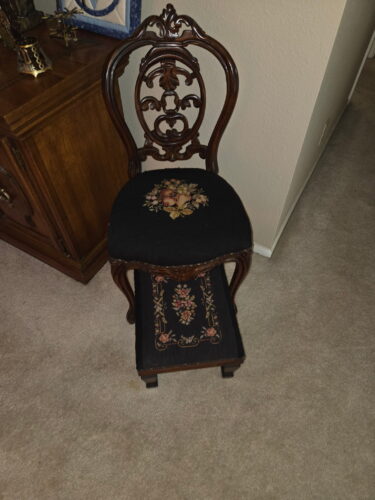
My Grandma Post (my mom’s mom), of blessed memory, needlepointed a chair and matching ottoman that is arguably more than 100 years old. I don’t know exactly how long it took her to complete it, but anyone who has ever done needlepoint can appreciate the patience required to stitch something so intricate. Thousands upon thousands of individual stitches, each one placed by hand. It is beautiful, certainly. But what makes it valuable has very little to do with what it might be worth.
For many years, the chair and ottoman sat in my grandparents’ home in St. Louis Park (MN). After my grandpa passed away in 1982 and my grandma moved to Florida (as so many do!), the chair and ottoman went to my aunt and uncle (my mother’s brother and sister-in-law) in Chicago, where they remained for more than four decades. Following my uncle’s death last summer, my aunt moved back to Minneapolis, and my cousin shipped the chair and ottoman to my parents. For the time being, that is where they will stay.
What makes me smile is that I can’t remember anyone ever actually sitting in the chair. And I certainly don’t remember anyone putting their feet up on the ottoman.
Maybe we all instinctively understood what it took to create them, the hours of work and the love that went into every stitch. Or maybe someone tried sitting in the chair once and my grandma gave them one of those looks that only a grandma can give, and no one ever made that mistake again. I’m not sure. That part of the story may be lost to history.
And maybe that’s the point.
Family history is made up of the things we know for certain and the things we only think we remember. It lives in photographs with names written on the back, recipes made without measurements (like my grandma’s chili recipe!), jewelry passed from one generation to the next, stories told so many times that everyone knows when to laugh. And sometimes, it lives in a needlepoint chair and ottoman that no one is quite sure they are allowed to sit on.
These objects become touchstones. They connect us to people who are no longer here and to places that may no longer exist as we remember them. Their monetary value is almost irrelevant. Their real value comes from the stories we attach to them and our willingness to keep telling those stories.
As families change and generations pass, we each become temporary owners of these memories. Maybe “owners” isn’t even the right word. We are their caretakers and their protectors. We hold them for a while, add our own chapter and, hopefully, pass them along to someone who understands why they matter.
And preserving family history doesn’t have to mean keeping everything. We couldn’t possibly hold on to every dish, piece of furniture, photograph or keepsake that belonged to someone we loved (although I’m doing a pretty good job of trying). But we can preserve the stories. We can tell where the keepsake comes from, why it mattered and what we remember when we look at it.
The chair and ottoman have moved from Minnesota to Illinois and now to Phoenix, carrying with it the handiwork of a woman we all loved and a connection to generations gone by. Someday, it will undoubtedly move again, and someone else will become their protector.
And I hope when that happens, they’ll know the story.
Because without the story, eventually a chair is just a chair.