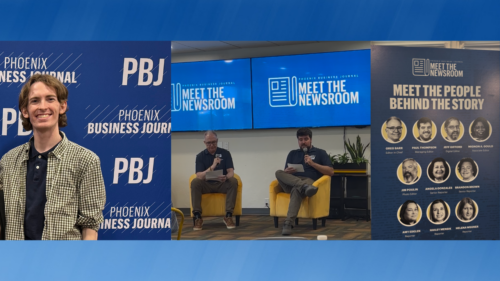
#MediaMonday – 12 Takeaways from Phoenix Business Journal’s Meet the Newsroom
One of the best ways to strengthen media relationships is to better understand the newsroom itself. The Phoenix Business Journal’s Meet the Newsroom event gave Valley communicators a rare inside look at how editors and reporters evaluate stories, what makes the news each day and how understanding their process can help us build stronger partnerships and tell better stories.
As the publication’s Executive Editor Greg Barr and Managing Editor Paul Thompson pulled back the curtain, here are some of the standout tips we received:
The Business Journal is digital first.
While the newsroom prioritizes breaking news online, reporters are still focused on in-depth business reporting and analysis readers expect across both digital and print platforms.
Be aware of their daily deadlines.
The newsroom structures much of its day around its morning and afternoon newsletters. By understanding those publishing cycles, you can pitch reporters when they have more opportunity to develop the story.
Find the right fit for your story.
Some stories may be better suited for an executive profile or recurring feature than a traditional news story. Understanding the Business Journal’s regular sections can help PR professionals identify the best opportunity for coverage.
The newsroom values exclusives.
Offering exclusive, undistributed news first to the Phoenix Business Journal can make a pitch more compelling, but an exclusive should also come with real access to executives and key stakeholders.
Awards are important opportunities.
Award submissions, like the Phoenix Business Journal’s 40 Under 40 and Best Places to Work, are meaningful ways to engage with the publication while spotlighting a leader or organization. Strong nominations also help the newsroom identify notable companies and leaders for future coverage opportunities.
Lead with the story, not the announcement.
A press release is only the beginning of the conversation. It’s a jumping-off point for the story. A “Business Journal story” includes context, interviews and business insights, rather than simply rewriting a release. Come with a clear vision for the story and why it matters.
Know “Why Should Our Readers Care?”
A successful pitch, and ultimately a story, shouldn’t just be important to a company. It should matter to the Phoenix business community and be relevant to business leaders in the local market.
Bring the reporter a complete package.
The stronger the initial pitch, the less time reporters spend chasing information and the more time they can spend telling the story.
Know your numbers.
Business reporting relies on specific details, and business readers expect them. Have the numbers ready, including project costs, investments, financing, sale prices, revenue and jobs created, to clearly illustrate the story’s significance and newsworthiness. The newsroom may uncover details even when a company does not provide them voluntarily.
Growth Makes the Story.
Anniversaries alone are not a story. Instead, focus on business growth, jobs created, investments made or major projects tied to the milestone to create a stronger angle. Future plans are often more compelling than past accomplishments, so tell reporters what’s next instead of just what you’ve already achieved.
Not every conversation has to become a story.
Sometimes the best outcome of a media interaction isn’t a story, but a new relationship made. Introduce yourself, ask questions, learn what reporters cover and become a trusted resource for future opportunities by knowing what they want and delivering it.
Relationships don’t only exist over email.
Coffee, lunch, networking events and other face-to-face interactions can build familiarity and trust with members of the media. Don’t limit your communication to email. Take the time to build genuine relationships.